How to Build Laser-Like Concentration in a Distracted World
Effective focus strategies can turn a distracted, foggy mind into a tool that feels sharp, calm, and under your control. In a world where notifications, deadlines, and constant scrolling compete for your attention, staying mentally present is a real cognitive skill—not a personality trait you either have or don’t. This article breaks down how attention works, then gives you science-based, practical steps to improve your concentration, clarity, and test-taking stamina.
Why Your Brain Struggles to Stay on One Thing
If you’ve ever opened your laptop to “quickly” check an email and resurfaced 45 minutes later from a social media rabbit hole, you’ve experienced how fragile attention can be. Modern life is engineered for micro-distractions: message previews, news alerts, group chats, streaming platforms, and browser tabs constantly invite your brain to switch tasks.
From a cognitive science perspective, this is costly. Each time you switch tasks, your brain pays a “switching tax.” Lab studies show that frequent task-switching can reduce performance on complex tasks by up to 40%, because your working memory and executive control systems need time to reorient. Research from attention scholar Gloria Mark and others suggests that after a significant interruption, it can take many minutes before you’re fully immersed again in your original task.
For people already prone to distractibility, such as many individuals with ADHD traits, the modern digital environment amplifies existing challenges. But regardless of your personality type or neurotype, attention is trainable. Just as cardiovascular fitness improves with regular exercise, your ability to stay with a demanding English reading passage, a tricky logic puzzle, or a long IQ practice set can be strengthened over time.
A Short Story: Rebuilding Focus Before a High-Stakes Test
Consider Alex, a 24-year-old preparing for a battery of aptitude and IQ assessments as part of a graduate admissions process. The tests included timed English comprehension, pattern-recognition tasks similar to Raven’s Progressive Matrices, and numerical reasoning. On the first practice attempt, Alex felt scattered: rereading questions, checking messages between sections, and missing obvious patterns. The scores were average, but far below what friends expected given Alex’s academic history.
Instead of concluding “I’m just not smart enough,” Alex reframed the problem as one of attention, not raw ability. Over the next three weeks, Alex made a few deliberate changes:
- Set a daily 45-minute “deep work” block with the phone in another room and all notifications off.
- Practiced reading dense English articles aloud, summarizing each paragraph in a sentence without looking back.
- Worked on 15–20 minutes of abstract reasoning problems every other day, focusing on accuracy before speed.
- Added short movement breaks—walking or stretching for five minutes between intense sessions.
The result? On the next practice test, Alex didn’t just feel calmer; performance improved significantly. Timed pattern-recognition accuracy rose, and reading comprehension errors dropped. It wasn’t magic—just consistent, structured attention training. This kind of story isn’t unusual; it’s what happens when people treat attention like a skill rather than a fixed trait.
The Science of Attention: What Cognitive Tests Reveal
Psychometric research offers useful clues about how attention, reasoning, and learning interact. Modern IQ tests, for example, are typically normed so that the average score in the general population is set to 100, with a standard deviation of 15. That means most people cluster between about 85 and 115, with fewer people at the very high or very low ends of the curve.
Tasks such as Raven’s Progressive Matrices are widely used to assess abstract reasoning: your ability to detect patterns, relationships, and logical rules in visual information. These tasks are deliberately designed to be culture-fair and language-light, which makes them popular in international aptitude testing, creativity research, and even some high-level recruitment processes.
Performance on these tasks depends on more than innate ability. It draws heavily on working memory (holding pieces of information in mind), inhibitory control (resisting irrelevant details), and sustained attention (staying engaged across many similar items). If you arrive mentally scattered, even strong reasoning skills can be underused.
Psychometrics also teaches us about practice effects. When people re-take similar IQ or aptitude tests, their scores often rise slightly—not because their underlying general intelligence has dramatically changed in a week, but because they’re more familiar with the format, timing, and expectations. They’ve learned how to allocate attention efficiently: when to linger on a hard matrix problem, when to skip and return later, and how to maintain concentration for the entire testing window.
In this sense, solid focus strategies don’t magically raise your IQ, but they help you express your current potential more fully, especially under time pressure. They also reduce the mental “noise” that can make creative connections and complex problem-solving feel harder than they need to be.
Practical Tactics to Clear Mental Fog and Stay On Task
Below are evidence-informed, highly actionable approaches to strengthen concentration. You don’t need to implement all of them at once; start with one or two, experiment for a week, and adjust based on your personality and goals.
1. Design an Environment That Makes Distraction Harder
Your surroundings can either constantly tempt your brain, or quietly support your ability to think. Small tweaks add up.
- Go “phone out of reach,” not just “silent.” Putting your phone across the room (or in another room) significantly reduces the urge to check it. Even a silent phone within arm’s reach occupies mental space.
- Use single-purpose devices when possible. If you’re reading an English article or solving a practice test, consider printing it or using a dedicated e-reader. Fewer apps = fewer entry points for distraction.
- Declutter your visual field. Clear your desk of unrelated items. For 45 minutes, you only need what serves the current task: notebook, pen, test booklet, or screen with a single relevant tab.
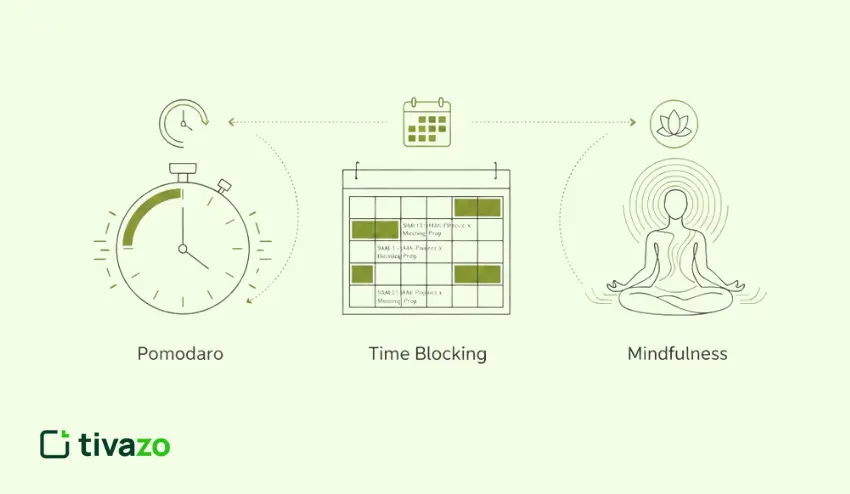
2. Time-Box Your Effort with Structured Focus Sessions
Unbounded work (“I’ll just study all evening”) invites procrastination. Time-boxing gives your brain a clear start and finish line.
- Try the 25/5 pattern for ramping up. Work 25 minutes on a single task, followed by a 5-minute break. During the 25 minutes, no messaging apps, no tab-switching, no “quick checks.” Increase to 40/10 or 50/10 once your stamina improves.
- Define success before you start. Instead of “study for IQ test,” try “complete two sets of abstract reasoning items and one set of English comprehension questions.” Specific goals keep you engaged.
- End with a tiny review. In the final 2 minutes, jot down what went well, what distracted you, and what you’ll change next time. This turns each session into feedback for the next.
3. Train Your Cognitive “Hardware” Gently but Consistently
Attention, working memory, and processing speed are like muscles—sensitive to both overload and underuse. You don’t need fancy apps to train them; simple, deliberate practice works.
- Read slightly above your comfort level. Choose English texts that challenge you: science articles, essays, or analytical writing. After each paragraph, summarize it in your own words. This strengthens comprehension and active engagement.
- Practice pattern recognition without pressure. Spend 10–15 minutes a few times a week on pattern-based puzzles, matrices, or logic grids. Focus on understanding the rules behind each item, not just getting the right answer quickly.
- Test your sustained attention. Try a simple continuous performance or go/no-go task online and notice how your focus drifts over a few minutes. Start the test now, then reflect on when your mind wandered and what triggered it.
Remember that more isn’t always better. Very intense daily training without rest can lead to mental fatigue. Aim for consistency—short, high-quality sessions over weeks—rather than marathon days followed by burnout.
4. Use Your Body to Support Your Brain
Cognitive performance isn’t just “in your head.” Biological factors heavily influence how well you can focus.
- Prioritize sleep before big tests or demanding work. Even a single night of short sleep can impair working memory and attention, leading to more mistakes on timed items. Aim for regular, sufficient sleep in the days leading up to important tasks, not just the night before.
- Move regularly, even briefly. Short walks, stretching, or light exercise increase blood flow and can clear mental fog. For many people with ADHD traits, structured movement before a focus session significantly improves on-task behavior.
- Manage simple physiological needs. Dehydration and low blood sugar quietly sabotage concentration. Drink water and choose steady-energy snacks (nuts, yogurt, fruit) rather than heavy, sugar-loaded foods that create an energy crash mid-session.
5. Match Strategies to Your Personality—But Don’t Be Limited by Labels
Personality frameworks like MBTI can offer language for preferences (for example, introverts favoring quiet spaces, extroverts enjoying more social energy). Use these as starting points, not rigid rules.
- If you recharge alone, you might do your deepest work in silent, solitary blocks, saving collaboration for lighter tasks.
- If you gain energy from people, consider structured co-working: studying in a library, joining a quiet online study room, or tackling practice questions with a partner who stays off their phone.
- Experiment and collect data on yourself. Treat your attention like an experiment: log when and where you’re most focused, which tasks feel easy or hard at different times of day, and adjust accordingly.
Bringing Your Attention Training Plan to Life
At its core, attention is about what you choose to protect. In an environment that constantly nudges you to react, you’re choosing instead to act with intention. Whether you’re preparing for an IQ assessment, improving your English reading stamina, or unlocking more of your creative potential, the methods are similar: reduce noise, structure your effort, and train your brain gently but persistently.
In the psychometrics world, we care deeply about fair measurement. When you walk into a test room tired, distracted, and scattered, the scores you obtain may underrepresent your true capabilities. By applying focus strategies consistently, you create conditions where your existing reasoning, verbal, and creative strengths can actually show up—on paper, in exams, and in everyday life.
As you move forward, avoid perfectionism. You will still have off days, wandering thoughts, and moments of mindless scrolling. The goal isn’t to become a flawless productivity machine; it’s to increase the proportion of your time spent in clear, deliberate engagement with what matters to you. Choose one or two focus strategies from this article, try them for a week, and treat your own experience as the most important data point.
FAQ
Does struggling to focus mean I have a low IQ?
No. Difficulty concentrating does not automatically mean low intelligence. Average IQ scores are normed so that most people fall near 100, with a standard deviation of 15, but performance on any given test is influenced by many situational factors: sleep, stress, familiarity with the format, test anxiety, and current life pressures. Improving your attention and test-taking habits helps your score more accurately reflect your existing abilities, whatever your starting point on the IQ scale.
Can focus really be trained, or am I stuck with how my brain is?
Attention is highly plastic. While people differ in their natural baseline (and some conditions, such as ADHD, make sustained focus harder), research consistently shows that targeted practice, environmental design, and habit-building can substantially improve how long and how effectively you can concentrate. You may never enjoy eight-hour, non-stop study marathons—and you don’t need to. The aim is to build reliable, high-quality focus blocks that fit your life and cognitive profile.
How long does it take to see improvements in concentration?
Many people notice small improvements in as little as one to two weeks when they consistently practice structured focus sessions (for example, daily 25–45 minute blocks) and reduce obvious distractions. More substantial changes in stamina and mental clarity typically emerge over four to eight weeks of regular practice, similar to a fitness program. The key is to track what you’re doing, adjust based on your experience, and give your brain time to adapt.

Related resources
focus strategies: improve your results by practicing and tracking progress.