Cognitive skills are the mental processes that let you learn, remember, focus, solve problems, and adapt in a fast-changing world. In an era of constant notifications and endless information, these abilities are under more pressure than ever. The same devices that help you work, study, and connect can also fragment your attention and overload your mind. This article explores how to strengthen your thinking in a tech-driven environment—using science, smart habits, and the right tools.
How the digital world hijacks (and can help) your attention
Imagine Alex, a 27-year-old software engineer. His day starts with a quick email check, but within minutes he has bounced through three messaging apps, two news sites, and a social feed. By 10 a.m., he has already switched tasks dozens of times. He feels busy but strangely unfocused, and truly deep work keeps getting pushed to “later.”
Alex’s story is familiar because today’s apps are designed to compete for attention. Every ping, preview, and red badge is a micro-interruption that pulls working memory away from what matters. Research on task switching consistently finds that even brief distractions can create a “residue” in your mind—part of your attention stays stuck on the last task, slowing your return to the present one.
The tech era isn’t only a threat, though. The same world that overwhelms you with information also provides powerful tools: adaptive brain-training apps, audiobooks and courses, AI writing assistants, spaced-repetition flashcard systems, and online IQ and aptitude tests. The key is to move from being a passive consumer of digital stimuli to an active designer of your digital environment.
What science tells us about thinking ability
When people talk about improving cognitive skills, they often think only of IQ. In standardized IQ tests, scores are typically normed so that the average is 100 with a standard deviation of 15. That means about two-thirds of people score between 85 and 115, and scores much higher or lower become progressively rarer.
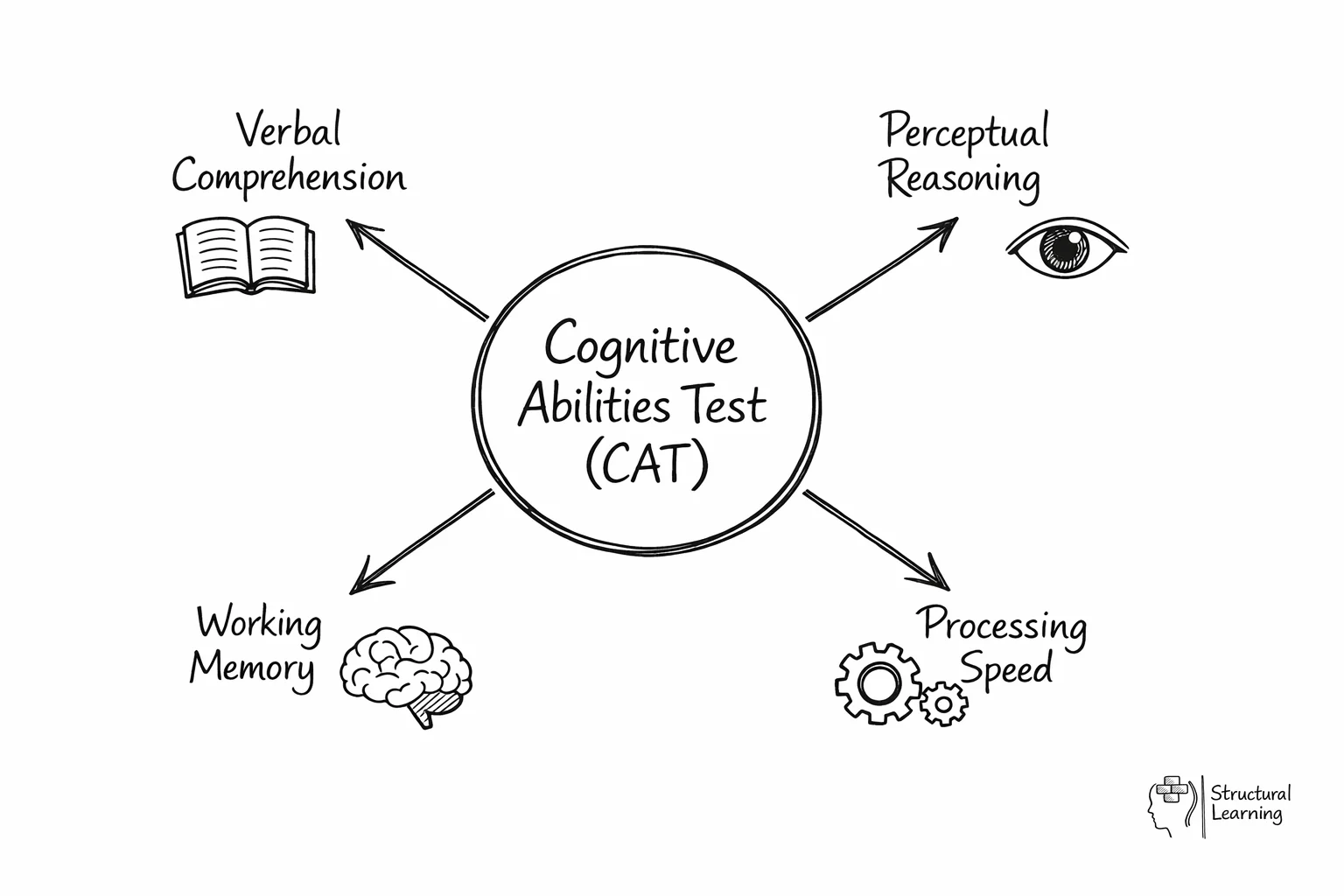
But IQ is not a single, fixed number etched into your brain. Modern psychometrics looks at multiple components: working memory, processing speed, verbal understanding, and fluid reasoning (your ability to solve new problems without relying on what you already know).
To measure fluid reasoning, psychologists often use tasks such as Raven’s Progressive Matrices. In these puzzles, you see a pattern of shapes with one piece missing and must choose the option that best completes the pattern. Because they rely on abstract visual patterns rather than language, they are widely used to assess reasoning across cultures and languages.
Another important insight from testing research is the existence of practice effects. People who become familiar with the format of IQ or aptitude tests—multiple-choice questions, matrix puzzles, or timed tasks—often see small score increases when they repeat similar tests. This doesn’t necessarily mean their underlying ability has changed dramatically; rather, they have learned how to navigate the test more efficiently. Strategically, you can use this to your advantage by reducing test anxiety and learning typical item formats before sitting a high-stakes exam.
For daily life, the takeaway is straightforward: your mental performance is shaped by both underlying ability and learned strategies. You may not transform your baseline IQ, but you can become dramatically more effective at focusing, problem-solving, learning, and using your strengths—especially in a tech-heavy environment.
Training your mind like a muscle in a screen-first world
1. Take control of your digital environment
Your devices can either drain or support your mental energy. Start by auditing your current digital habits:
- Notifications: Turn off non-essential alerts. Keep only those directly related to your priorities: calendar reminders, important work messages, or time-sensitive personal contacts.
- Home screen design: Move distracting apps (social media, games, shopping) off your first screen. Put learning tools, reading apps, note-taking software, and calendars front and center.
- Single-task windows: During focused work, keep only the relevant tabs and apps open. Use browser extensions or focus modes that block distracting sites during set hours.
- Scheduled scrolling: Instead of constant micro-checks of feeds, allocate short, specific windows for “digital grazing” so that you protect longer blocks of deep work.
Designing your environment like this reduces the number of decisions your brain must make and frees up mental bandwidth for real thinking.
2. Build deep work blocks to strengthen attention
In a world of constant partial attention, the ability to sustain focus is a competitive advantage. Deep work sessions are like gym workouts for your concentration. Here’s how to structure them:
- Start small: Begin with 25 minutes of uninterrupted work (the classic Pomodoro method), followed by a 5-minute break. Over time, lengthen the focus intervals to 40–60 minutes with 10–15 minute breaks.
- Define your target: Before each block, write down a single clear outcome: “Outline section 2 of my report” or “Practice 15 English vocabulary cards.” The narrower the goal, the easier it is to resist distractions.
- Remove temptations: Put your phone out of reach and out of sight, preferably in another room. On a laptop, use full-screen mode for your main task.
- Debrief briefly: At the end of each block, note what worked and where you got distracted. This helps you refine your environment and techniques next time.
As you consistently practice deep work, your capacity for sustained attention improves, and tasks that once felt mentally exhausting become more manageable.
3. Sharpen working memory and reasoning with targeted exercises
Working memory—the ability to hold and manipulate information in your mind over short periods—is central to reading, mental math, problem-solving, and following complex instructions. While the research on long-term transfer from “brain games” is mixed, certain activities are clearly useful as mental training, especially when combined with real-world learning.
- Reasoning puzzles: Logic puzzles, pattern-based games, and matrix-style tasks similar to Raven’s Progressive Matrices can help you become faster and more comfortable with abstract reasoning. Some online IQ practice platforms provide timed sets; use them to learn item types rather than obsess over scores. Start the test now if you want to simply experience how such puzzles feel under time pressure.
- Working-memory drills: Try simple mental exercises: repeat back sequences of numbers in reverse order, mentally rearrange words alphabetically, or visualize short stories and recall each detail. Gradually increase the complexity.
- Spaced repetition for learning: Use spaced-repetition apps (like digital flashcards) to commit vocabulary, formulas, or technical concepts to long-term memory. Efficient recall frees up working memory for more complex thinking.
The goal isn’t to chase perfect scores on online tests but to become more fluent at holding, transforming, and applying information—skills that pay off in studying, problem-solving, and fast-changing workplaces.
4. Support mental clarity with sleep, movement, and nutrition
In discussions about IQ or personality, people often overlook that your brain is also a biological organ. Simple lifestyle shifts can create surprisingly large improvements in how clearly you think.
- Sleep: Aim for consistent bed and wake times. Even a single night of poor sleep can impair attention and working memory as much as moderate alcohol intake.
- Movement: Short bouts of exercise—brisk walking, cycling, or bodyweight routines—boost blood flow to the brain and are associated with better executive functioning. Consider “movement snacks” between deep work sessions.
- Nutrition and hydration: Stable blood sugar supports stable focus. Favor whole foods and avoid heavy, ultra-processed meals during intense mental work. Don’t underestimate basic hydration; mild dehydration can subtly dull concentration.
These changes are not glamorous, but they multiply the effect of every other mental-training strategy you use.
5. Use personality and aptitude insights as tools, not labels
Many people turn to MBTI, creativity tests, ADHD self-checklists, or aptitude assessments to understand how they think. These can be helpful mirrors—but only when used carefully.
- See patterns, not destiny: If a personality profile says you tend to be intuitive rather than detail-focused, use that information to plan your work: pair big-picture brainstorming with structured checklists, for example.
- Match tasks to strengths: Strong verbal thinkers might gravitate toward writing, languages, or argumentation, while highly visual reasoners may excel in design, engineering, or spatial problem-solving.
- Avoid self-limiting stories: Labels like “not a math person” or “too scattered to focus” can become self-fulfilling. Instead, treat test feedback as a starting hypothesis about how you learn best, then experiment.
If you have persistent attention, mood, or learning difficulties that interfere with daily life, it can be useful to speak with a qualified professional rather than relying solely on online tests. Self-knowledge is powerful, but it needs to be grounded in reality and used to guide constructive change.
Fitting smarter habits into a busy, tech-heavy life
Knowing what supports clear thinking is one thing; making it fit into your real schedule is another. A few strategic approaches can help:
- Habit stacking: Attach new mental habits to existing ones. For example, after your morning coffee, you might do one 25-minute deep work block. After lunch, you might spend 10 minutes on reasoning puzzles.
- Minimal viable change: Instead of a dramatic digital detox, start by removing just one distracting app from your home screen or setting a single 60-minute no-notification window each day.
- Use technology intentionally: Treat apps as tools with specific purposes: one for spaced repetition, one for focus timing, one for note capture. Avoid installing overlapping tools that increase complexity and distraction.
- Review weekly: Once a week, reflect for 10 minutes: What helped me think clearly? What drained me? Adjust your environment and routines accordingly.
Over time, these small, consistent choices accumulate into noticeable gains in clarity, learning speed, and mental stamina—without requiring you to abandon technology altogether.
A smarter relationship with technology and your mind
You live in a world where information is abundant, attention is scarce, and mental energy is one of your most valuable resources. Instead of viewing technology as the enemy, you can reshape your digital life to amplify your strengths: focused work blocks instead of constant multitasking, targeted reasoning practice instead of random scrolling, and deliberate rest instead of endless late-night screen time.
By understanding how your mind really works—its limits, its biases, and its enormous capacity for adaptation—you can protect and enhance your cognitive skills while still taking full advantage of what modern tools offer. The question is no longer whether technology will shape your thinking, but whether you will shape that process consciously. The sooner you start designing that relationship, the sharper, calmer, and more creative your thinking can become.
Common questions on boosting mental performance
Can online IQ tests genuinely improve my thinking, or just my scores?
Practicing with online IQ and aptitude tests can produce two outcomes. First, you often see modest score increases due to practice effects—becoming familiar with question formats, time limits, and common traps. Second, certain skills such as pattern recognition, mental arithmetic, and verbal reasoning may become faster through repetition. However, the deepest gains come when you connect these drills to real tasks: studying, problem-solving at work, or learning a new language, rather than focusing solely on test numbers.
How much does screen time really affect focus and attention?
It isn’t only the number of hours in front of a screen that matters, but the type of use. Rapid-fire switching among apps, notifications, and short-form content trains your brain toward shallow, fragmented attention. In contrast, using screens for sustained reading, structured courses, or deep work can actually support stronger concentration. Track your digital behavior for a few days and distinguish between “fragmenting” and “focused” screen time; then intentionally shift time from the former to the latter.
Are personality types like MBTI useful for choosing study or career paths?
Personality frameworks such as MBTI can be helpful starting points for self-reflection, highlighting whether you naturally lean toward introversion or extroversion, intuition or detail focus. They should not, however, be treated as rigid prescriptions. When exploring study or career directions, combine personality insights with objective data from aptitude or skills tests, feedback from real tasks, and your own experience of what energizes you. Use these tools to design better strategies and environments, not to limit your options.
Related resources
cognitive skills: improve your results by practicing and tracking progress.