
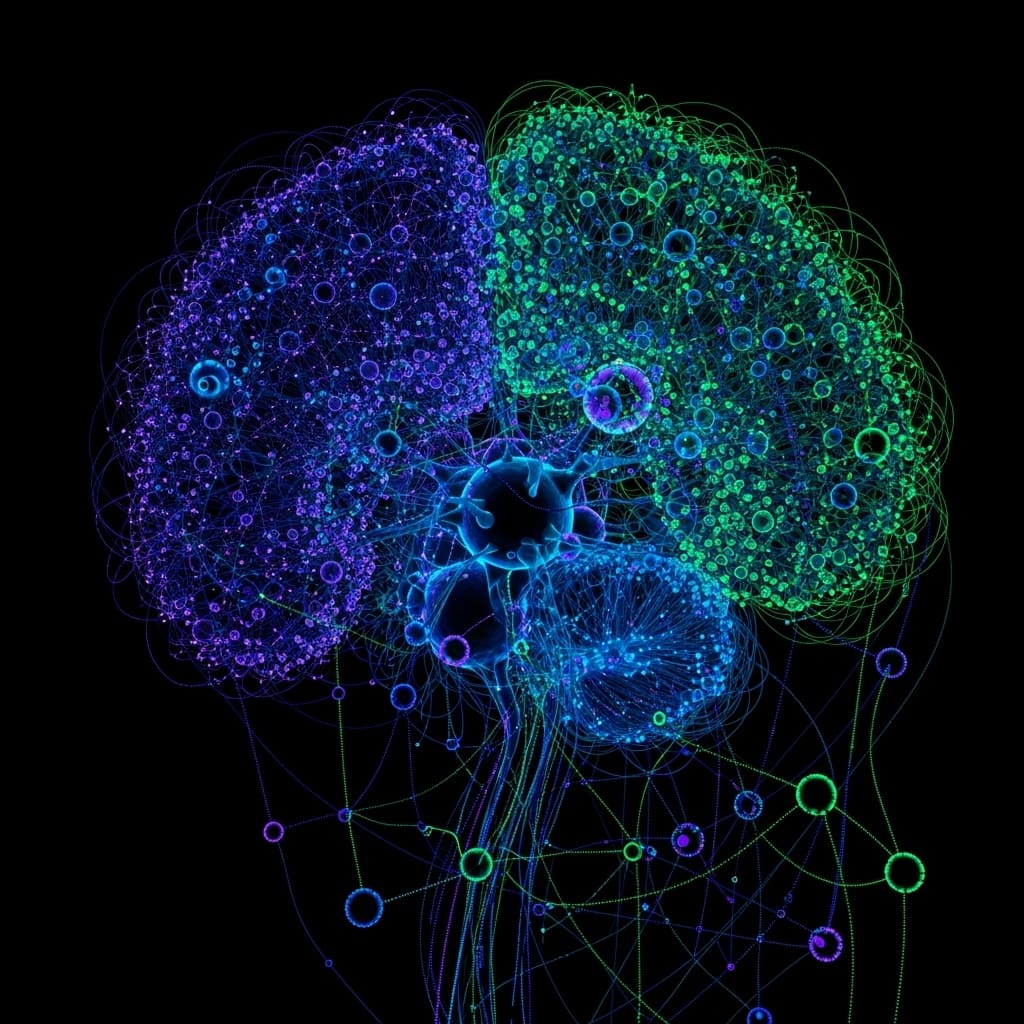
Brain networks shape how we focus, remember, and solve problems, and they quietly nudge us toward certain learning preferences over others. When you understand how these systems cooperate and compete, it becomes easier to see why some tasks feel natural while others feel exhausting. This insight is not just interesting neuroscience trivia; it can guide how you study, choose careers, and design personal growth plans that match the way your mind actually works.
From Hidden Wiring to Everyday Learning Moments
Imagine two people sitting in the same classroom, watching the same video lecture on creativity and problem-solving.
Jordan is taking notes in color, drawing little diagrams of the concepts as the teacher speaks. The material lights Jordan up; ideas connect quickly, and by the end of the session, there is a mind map covering half the notebook page.
Sam, on the other hand, listens politely but feels the concepts sliding away. When the teacher switches to a hands-on activity—asking everyone to design a new app feature using sticky notes and group discussion—Sam suddenly comes alive. Talking, debating, moving bits of paper around the table: that is when the information “clicks.”
Neither Jordan nor Sam is smarter than the other. They are simply using different circuits in the brain more efficiently, drawing on different patterns of attention, memory, and motivation. Those differences show up as “learning preferences”: visual vs. verbal, solitary vs. social, hands-on vs. conceptual.
When you start to recognize these recurring patterns in yourself, you can stop forcing your mind into methods that burn energy and start building study, work, and personal-development routines that match your natural strengths.
The Three Big Systems Behind Focus, Imagination, and Flexibility
Researchers often describe three major brain networks that work together when you learn something new or practice a skill:
1. The imagination system (often called the default mode)
This system is most active when your mind wanders, daydreams, or reflects. It helps you:
- Envision future possibilities
- Connect new ideas to your past experiences
- Generate creative associations and “aha” insights
People who love reflective journaling, conceptual discussions, or free-form brainstorming may be leaning heavily on this system. If you recognize yourself here, you might learn best when you first get time to “just think about” an idea before you’re asked to apply it.
2. The focus-and-control system (often called the executive network)
This system turns on when you:
- Resist distractions for a challenging task
- Follow multi-step instructions
- Hold information in mind while manipulating it (like mental math)
If you enjoy logic puzzles, strategic games, or systematically breaking a big goal into sub-tasks, this system may be a strength for you. Many classic aptitude and IQ tasks—like solving patterns, sequences, or analogies—lean strongly on this network’s ability to organize and monitor your thinking.
3. The switching-and-relevance system (often called the salience network)
This system constantly asks, “What deserves attention right now?” and helps you:
- Shift between imagination and focused work
- Notice important cues in your environment (a teacher’s hint, a bolded sentence, a timer beeping)
- Adjust your strategy when something stops working
If you find it easy to “read the room,” adapt quickly, or jump between tasks without losing the plot, this system may be doing its job efficiently. When it’s harder to filter noise or shift tasks, learning can feel more tiring—even if your raw reasoning ability is high.
Learning preferences often reflect which of these systems feels easiest to recruit and sustain. For example, someone who loves structured outlines and step-by-step logic might naturally lean on the focus-and-control system, while a highly imaginative person may initially rely more on the imagination system and only later tighten ideas into a plan.
What IQ and Aptitude Tests Really Tap Into
Many people first encounter questions about their own thinking style through IQ or aptitude tests, whether at school, online, or in preparation for competitive exams. Understanding what these tests actually measure—and what they miss—can help you use them as tools for growth rather than labels.
Modern IQ tests are typically scored so that the average IQ is set to 100, with a standard deviation of 15. That means most people cluster somewhere between about 85 and 115, with fewer people at the very high and very low ends. This distribution says more about how you compare to your age group on specific tasks than about your value as a learner.
Many nonverbal reasoning tests look a lot like puzzles. For example, Raven’s Progressive Matrices are widely used to assess abstract reasoning. You see patterns of shapes in a grid with one space missing and must choose the option that logically completes the pattern. To solve this efficiently, you rely on:
- Visual attention (spotting recurring features and changes)
- Working memory (holding several rules in mind)
- Cognitive flexibility (testing different hypotheses until something fits)
Those abilities draw on both your focus-and-control system and your switching-and-relevance system. If you like this kind of puzzle, you might also enjoy logic-based learning strategies: flowcharts, concept maps, or working through example problems step by step. Start the test now might feel like an exciting invitation to you rather than a threat.
It is also important to remember that scores can shift over time. Psychologists talk about practice effects: familiarity with formats can slightly improve scores, especially when you first encounter reasoning tasks that look nothing like the problems you usually solve in daily life. Someone might initially underperform simply because the style is new, not because their brain is less capable.
This is good news for personal development. It suggests that when you practice the kinds of mental moves a test requires—holding patterns in mind, switching strategies, staying with a hard problem a little longer—you are not just “gaming the test.” You are training attention, flexibility, and persistence that also support real-world learning.
Story: Two Learners, Same Course, Different Paths
Consider a real-world example from an online course in data analysis taken by two friends, Maya and Leo.
Maya’s path
Maya has always loved languages and writing. She signs up for the course because she wants to understand data better for her psychology research. As she watches the first lecture, filled with equations and charts, she feels her attention drifting.
But when she finds a blog post that explains the same concepts using analogies and simple stories, everything makes sense. She rewrites each formula in her own words, invents metaphors, and talks through the steps as if she were teaching a friend. Her imagination system does the first pass: “This formula is like a balance scale; here’s what each side represents.” Then her focus-and-control system kicks in to handle the step-by-step calculations.
Leo’s path
Leo, in contrast, has always loved puzzles. He sees the equations and feels a thrill. He pauses the lecture constantly to try the problems on his own before the instructor solves them. For Leo, dense symbolic information is energizing; the structure is the story.
Yet when the instructor asks students to write a reflective piece connecting the math to real-world questions, Leo stalls. He understands the procedure but struggles to explain why it matters in words.
Same goal, different strategies
Both students finish the course successfully, but they get there through different routes:
- Maya leans on narrative and examples, then practices until the formal steps feel natural.
- Leo leans on patterns and rules, then stretches himself to express those ideas in language.
Neither approach is the “right” one. Each person is discovering how to recruit their strongest mental systems first and then build bridges to weaker, but still trainable, skills.
Practical Ways to Learn in Sync With Your Brain
Understanding how these internal systems operate is only useful if it translates into concrete changes in how you study, work, and practice new skills. The following strategies can help you align learning with your mind’s natural tendencies while still challenging yourself to grow.
1. Notice what genuinely feels easier (and what always drains you)
Instead of guessing your learning style from a label, track your real experiences for a week or two:
- Which activities make time pass quickly—reading, listening, doing, discussing?
- When do you feel “in the zone,” and what exactly are you doing?
- Which tasks leave you mentally exhausted, even if they look easy on paper?
Write down specifics: “I understood the podcast faster when I paused and sketched the ideas,” or “I got more from the article when I summarized each section out loud.” These small experiments tell you which internal systems you naturally recruit.
2. Match the first pass of learning to your sweet spot
For initial exposure to new material, choose a format that fits your strengths:
- If you’re imaginative and verbal, start with stories, analogies, and real-world examples before diving into formulas or tight rules.
- If you’re systematic and pattern-focused, begin with clear structures: outlines, worked examples, and step-by-step walkthroughs.
- If you’re highly social, use study groups or teaching others as your first line of engagement.
Later, you can deliberately shift into less comfortable formats to deepen understanding. But using your natural preference first lowers resistance and lets you build a mental scaffold before you climb.
3. Train your weaker systems in short, deliberate bursts
Personal growth often means strengthening the systems you don’t naturally lean on. The key is to do this gradually, not by forcing yourself into exhaustion.
- If sustained focus is hard, start with 10–15 minute “sprints” on a single task, followed by a short break. Gradually extend the work segments.
- If flexible thinking is tough, practice with low-stakes puzzles or creativity prompts where there’s no penalty for trying multiple approaches.
- If reflection is uncomfortable, try a three-line daily journal: “What I learned, how I felt, what I’ll change next time.”
You’re effectively cross-training your mind, just as an athlete might alternate strength, flexibility, and endurance workouts.
4. Use tests as mirrors, not verdicts
Aptitude tests, IQ tests, MBTI questionnaires, and creativity assessments can offer clues about your strengths and tendencies—but they are snapshots, not sentences.
When you receive a score or a profile, ask:
- Which parts of this result feel accurate based on my real-life behavior?
- Where might unfamiliar formats or anxiety have held me back?
- What is one small experiment I can do this week using this information? (For example, try a new study technique suggested for your profile.)
If a score seems lower than you expected, remember those practice effects: exposure to a test’s logic and style can improve performance. The deeper value is not the number itself but the insight into how you approach unfamiliar problems.
5. Design “learning environments” that respect your brain
Instead of relying on willpower alone, shape your surroundings to support the way you learn:
- If you’re easily distracted, keep one clear, designated place where only focused work happens.
- If movement helps you think, allow yourself to walk while listening to lectures or reviewing notes.
- If you process best by teaching, schedule regular check-ins with a friend or study partner where you must explain concepts aloud.
The goal is not to avoid challenge, but to remove unnecessary friction so your effort goes into genuine learning, not constant self-battling.
Bringing Your Learning Journey Into Alignment
Understanding how your preferred strategies line up with your underlying brain networks is like getting a more detailed map of your internal landscape. It shows you the well-paved roads where you can move quickly and the rougher paths that may require more patience and support.
You do not need to become a neuroscientist to benefit from this knowledge. By observing your own patterns—how you pay attention, which formats engage you, how you respond to tests and feedback—you can choose learning methods that respect your wiring while gently stretching your limits. Over time, that combination of self-awareness and deliberate practice can turn studying, working, and even personal growth into a more sustainable, less self-critical process.
Questions Learners Often Ask
Is my learning style fixed, or can it change over time?
Your preferences are influenced by both your brain’s wiring and your experiences, but they are not rigid. With practice, you can become more comfortable with formats that once felt difficult—such as moving from purely visual learning to also handling dense text or vice versa. The key is gradual exposure, strategic support (like diagrams or summaries), and enough repetition for your brain to build new, more efficient pathways.
How do personality frameworks like MBTI relate to how my brain learns?
Personality frameworks such as MBTI can offer language for describing how you like to gather information (for example, more practical and concrete versus more abstract and theoretical) and how you make decisions. These preferences may correlate loosely with how you use imagination, focus, and flexibility in learning, but MBTI is not a direct measurement of brain function. Treat it as a reflective tool to experiment with different study methods, rather than as a strict scientific label.
Can training my attention help with distractibility, even if I suspect ADHD?
Yes, many people—whether or not they have ADHD—can benefit from attention-training strategies such as short, timed focus intervals, reducing distractions in their environment, and using external reminders or checklists. These approaches help your attention systems work more efficiently. However, they are not a substitute for a professional evaluation. If distractibility significantly affects your functioning, consider consulting a qualified clinician who can provide individualized guidance and, if appropriate, a formal assessment.

Related resources
brain networks: improve your results by practicing and tracking progress.