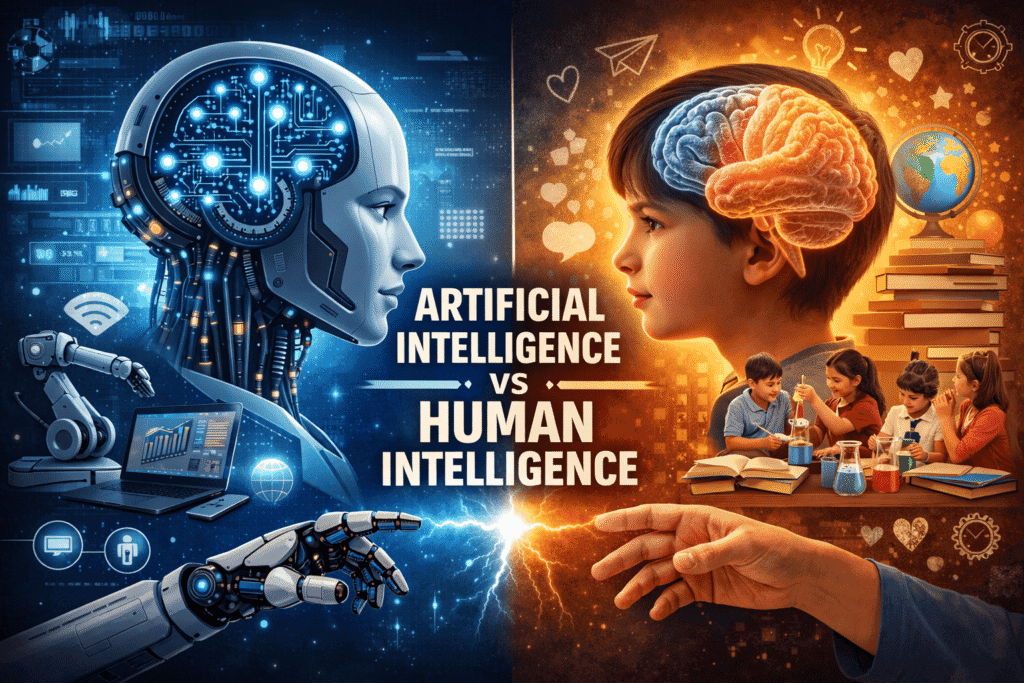
Human brain vs AI is often framed as a battle, but the real story is about collaboration. As language models, recommendation engines, and learning algorithms rapidly improve, it’s easy to forget how extraordinary your own mind already is. This article explores the unique strengths of human cognition—especially for creativity, problem-solving, and learning—and shows you how to use AI tools as amplifiers rather than replacements for your natural abilities.
When Algorithms Meet Imagination: A Classroom Story
Picture a high-school classroom where students are asked to design a short story based on a single, abstract image: a staircase fading into the clouds.
One student, Maya, opens an AI writing tool. In seconds, the system generates three neat story ideas: a sci-fi tale about space travel, a philosophical dialogue about heaven, and a mystery set in an old library. They are coherent, grammatically flawless, and… strangely predictable.
Another student, Leo, stares at the image a bit longer. His mind wanders. He remembers how it felt to move to a new country without speaking the language, the awkward first week at school, the sense of climbing invisible steps just to say “hello” confidently. He scribbles a concept: a staircase that appears only to children who feel out of place, leading to a rooftop where they meet others like them.
The AI’s ideas are technically solid, but Leo’s story hits the room differently. It feels personal, emotionally layered, and deeply human. His teacher uses the contrast as a talking point: the AI was great at listing plausible options, but Leo was the only one who could fuse memory, emotion, and meaning into something that made everyone else in the room feel understood.
That small scene captures a bigger truth. AI can remix patterns at incredible speed, but you bring lived experience, identity, and values. Creativity happens at that intersection, where raw information meets the messy, subjective, beautifully biased perspective of a human being.
How Human Cognition Really Differs from AI Systems
When people imagine the human brain vs AI, they often picture a race: who is faster, smarter, or more accurate? But cognitive science and psychometrics paint a more nuanced picture of what “smart” even means.
1. Intelligence tests measure slivers, not souls
In traditional psychometrics, human performance is often benchmarked using IQ tests, where the average IQ is set to 100 with a standard deviation of 15 points. This lets psychologists compare an individual’s performance to a large reference group on specific tasks like pattern recognition, vocabulary, or working memory.
For example, Raven’s Progressive Matrices are widely used to assess abstract reasoning through increasingly complex patterns. Researchers sometimes test AI systems on Raven-like items and report that a model performs at a “high IQ level.” But this can be misleading. An AI system may excel on a narrow class of problems while lacking the broader abilities that give human intelligence its richness: self-awareness, emotional nuance, moral judgment, and the capacity to change our own goals.
Even with humans, scores are not static. Practice effects exist: becoming familiar with question formats, time limits, or strategies can slightly improve test scores without necessarily reflecting a dramatic leap in underlying ability. AI, trained on massive datasets including test-like problems, benefits from an extreme version of this familiarity that no single human could ever replicate.
2. Context and meaning are your native language
Most AI systems excel at learning from huge numbers of examples. Show them millions of images, sentences, or test items, and they can approximate patterns well enough to be impressively useful. But they don’t truly “care” about the context in which those patterns appear.
You do. When you read a story, your brain doesn’t just parse words; it brings in your values, memories, cultural background, and bodily sensations. That’s why two people can read the same paragraph and walk away with completely different emotional reactions—and why group brainstorming often sparks more original ideas than any single autocomplete algorithm.
3. Attention, daydreaming, and “distractions” can fuel creativity
Many people with attention differences, including ADHD, describe their minds as constantly branching, jumping, and wandering. While that can be challenging in test-like environments, the same tendency to connect distant ideas can be a powerful advantage in creative work, from design and writing to entrepreneurship.
AI doesn’t naturally “daydream.” It follows the patterns it was trained on, generating what is statistically likely to come next. Your mind, by contrast, can suddenly link a childhood memory to a math problem, or a movie you watched last week to an idea for a new app. That leap—often happening when you are in the shower, walking, or half-distracted—is where originality lives.
Strengths You Have That Machines Still Can’t Match
Understanding what you do better than any algorithm is the first step to using AI wisely rather than anxiously. Here are human strengths that are extraordinarily hard to replicate computationally—and how they relate to creativity.
Emotional insight and empathy
AI can be trained to recognize emotional cues in text or voice, but it does not actually feel anything. You, however, use your emotions as a guidance system. Feeling embarrassed about a clumsy paragraph can motivate you to rewrite it more clearly. Feeling moved by a client’s story can inspire a better design, lesson plan, or product.
In creative collaborations, empathy lets you anticipate how real people—not idealized “users”—will respond. This is crucial in education, coaching, therapy, leadership, and any domain where ideas must land in human hearts, not just pass technical checks.
Value-driven decision-making
AI can help you generate options, but it does not have an internal compass. It optimizes for objectives defined by humans—clicks, accuracy, speed—not for wisdom, long-term growth, or fairness.
When you’re creating something new—whether it’s a lesson plan, a marketing strategy, or a piece of art—you are constantly trading off speed versus depth, novelty versus clarity, ambition versus well-being. Those trade-offs depend on what you value: inclusion, curiosity, justice, or stability. Only you can decide which outcomes matter most.
Cross-domain thinking from limited data
Most people can generalize from just a handful of experiences. A shy child who gives one successful presentation may suddenly feel more confident in other areas. A developer who learns a new algorithm can often apply the mindset to a completely different language or problem.
AI is powerful partly because it has seen more data than any one of us. But paradoxically, this can be a limitation: it tends to stay close to the statistical center of its training examples. You, by contrast, can jump to wild, cross-domain analogies—comparing a grammar rule to a jazz riff, or a productivity method to gardening—and those analogies can unlock insights you would never reach by following a straight line.
Practical Ways to Combine Your Brain and AI for Bigger Ideas
So how do you actually use AI to boost your creativity without dulling it? Think of AI as a power tool: amazing for certain tasks, dangerous if you hand it the entire blueprint. Here are concrete strategies you can start applying today.
1. Use AI for volume, keep humans for selection
AI is great at generating lots of options quickly—title ideas, example questions, study prompts, or alternative explanations of a concept. Instead of asking it for “the best” answer, ask for 10–20 rough options and then let your own judgment filter, remix, and elevate them.
For example, if you’re preparing for an aptitude test or IQ-style reasoning challenge, you might ask an AI tool to create several practice problems in a particular format. Your creative work is then to analyze which ones are genuinely challenging, write better versions, or invent patterns the tool didn’t consider. Start the test now, but pay as much attention to your thinking process as to your score; that metacognition is where growth happens.
2. Turn AI into a Socratic questioner, not just an answer machine
Instead of simply asking AI to solve problems, instruct it to ask you probing questions. For instance:
- “Act as an interviewer. I’ll pitch a product idea; your job is to challenge my assumptions.”
- “Ask me increasingly difficult ‘what if’ questions about this lesson plan until I discover at least two new angles.”
This turns the interaction into a mental workout. You stay in the driver’s seat, exercising reasoning, perspective-taking, and verbal creativity—skills relevant not only to IQ-style performance but also to leadership and communication.
3. Externalize working memory—especially helpful if your attention is scattered
If you tend to juggle many ideas at once or struggle with focus (as many people with ADHD or high creative drive do), use AI as an external notepad. Ask it to summarize your brainstorming session, track open questions, or list alternative paths you considered but didn’t choose.
This offloads some of the mental clutter so your brain can do what it does best: notice patterns, feel which option “clicks,” and envision how different choices might play out in real life.
4. Play “constraint games” to stretch originality
Paradoxically, constraints can make you more creative. Use AI to generate constraints, then challenge yourself to improvise within them. For example:
- “Give me three random words and a personality type; I’ll write a short scene connecting them.”
- “Propose an unusual limitation for a study schedule—like only 25 minutes per day—and I’ll design a plan that still works.”
These games train cognitive flexibility, an important component of both creative thinking and high-level problem-solving. The AI provides structure; your brain provides the leap.
Training Your Creative Mind Like a Psychologist
Psychometrics and educational psychology offer another key insight: the way you think about your own abilities shapes how far you can grow. Rather than viewing intelligence or creativity as fixed traits, treat them like skills you can train—partly with AI’s help.
Observe your thinking, not just your outputs
After you use AI on a task—planning a study session, drafting an email, generating analogies—pause and ask:
- What did I like or dislike about the AI’s suggestions?
- How would I have approached this problem without technology?
- Where did my ideas feel more insightful or more humane?
This kind of reflection strengthens metacognition: your ability to monitor and steer your own thinking. Strong metacognition predicts better learning outcomes across IQ levels, personality types, and domains.
Experiment with modes that fit your mental style
Some people, including many who resonate with intuitive MBTI types (like ENFP or INFJ), find that they think best through open-ended brainstorming and metaphor. Others, such as more analytical types (like ISTJ or INTJ), prefer structured outlines and step-by-step logic.
Try configuring AI to respond in ways that complement your style:
- If you’re highly intuitive, ask for clear structures and checklists to balance your big-picture thinking.
- If you’re highly analytical, ask for wild analogies or unexpected use cases to jolt you out of linear patterns.
By deliberately pairing your natural tendencies with contrasting AI support, you can stretch your creative range instead of staying in your comfort zone.
Why Your Messy, Human Mind Is Still the Point
AI will keep improving, and it will likely outperform humans on more and more narrowly defined tasks. But creativity thrives on more than pattern recognition. It depends on curiosity, emotion, identity, and the willingness to be surprised by your own thoughts.
Machines can help you practice, prototype, and polish at unprecedented speed. They can’t decide what matters, whom you want to serve, or what kind of world you hope your ideas will help create. When you recognize and train your uniquely human strengths—empathy, value-driven judgment, cross-domain insight—you don’t compete with algorithms on their terms. You redefine the game.
The future is not about choosing sides in a simplistic contest between carbon and silicon. It is about learning to design environments, habits, and tools where technology amplifies the best parts of being human—and where your creativity, not any algorithm, remains the main character.
Questions People Often Ask
Can AI ever reach or surpass human creativity?
AI can already produce outputs that look highly creative: original images, melodies, jokes, or story ideas. In specific domains with clear rules, it may even surpass average human performance. But human creativity is more than novel output. It is tied to consciousness, emotion, personal history, and the ability to change what we value over time. Even if AI becomes extremely capable at simulating creative behavior, there is an open philosophical question about whether simulation equals genuine creativity. For now, the most powerful results tend to come from human–AI collaboration, where people supply vision, taste, and ethical direction, and AI supplies speed and variation.
How can I use AI tools without becoming dependent on them?
Set clear boundaries and intentional roles for AI. Use it for tasks that are mostly mechanical—drafting outlines, generating examples, proofreading, or summarizing long texts—but keep core creative decisions in your hands. A helpful rule of thumb is: AI drafts, you decide. Regularly challenge yourself to complete some tasks without assistance so you continue building your own reasoning, writing, and problem-solving muscles. Reflect after each session on what you learned, not just what the tool produced; this keeps you in a growth mindset rather than a passive one.
Do IQ tests still matter in a world with powerful AI?
IQ tests and related measures, like abstract reasoning tasks, still provide useful information about certain aspects of human cognition—especially in educational and research settings. However, they were never designed to compare humans with machines or to capture the full range of human potential, including creativity, motivation, resilience, and social intelligence. As AI systems become more capable, it becomes even more important to interpret test scores in context: as one source of data about how someone learns and solves problems, not a verdict on their worth or future possibilities. In practical terms, developing your creative, emotional, and ethical skills will likely matter more for your long-term impact than any single number on a test report.
Related resources
human brain vs AI: improve your results by practicing and tracking progress.