
Elon Musk IQ captures the imagination of innovators and curious minds alike, fueling debates about the intellect driving his revolutionary companies like SpaceX, Tesla, and Neuralink. With feats that seem superhuman—from reusable rockets to AI advancements—many wonder: what number defines his genius? While no official score exists, exploring the elon musk iq phenomenon reveals profound insights into cognitive potential, self-improvement, and what truly powers extraordinary success in modern times.
Decoding the Elon Musk IQ Mystery
Speculation around Elon Musk’s IQ swirls in online forums, podcasts, and expert analyses, often pegging it in the genius range above 150. Though Musk hasn’t publicly disclosed an official test result, estimates draw from his problem-solving prowess, rapid learning across disciplines like engineering, physics, and neuroscience, and his ability to orchestrate multibillion-dollar ventures. In recent months, discussions have intensified with breakthroughs in Neuralink’s brain-computer interfaces and xAI’s pursuits, spotlighting how high cognitive function intersects with real-world impact.
Where Do These Estimates Come From?
Psychometric enthusiasts analyze Musk’s achievements using proxies like SAT scores from his youth or performance on informal puzzles. Tools such as Raven’s Progressive Matrices, prized for assessing abstract reasoning without language bias, align with traits evident in his innovations. Yet, remember that IQ is just one metric—average scores norm to 100 with a standard deviation of 15, placing geniuses in rarefied air above 145.
Current Trends: The Surge in Elon Musk IQ Curiosity
In today’s digital landscape, searches for ‘elon musk iq’ spike alongside viral clips of his interviews and product launches. Nowadays, platforms like X (formerly Twitter) buzz with threads dissecting his mental horsepower, especially amid ADHD awareness and neurodiversity conversations. Musk has openly shared his Asperger’s diagnosis, highlighting how neurodivergent traits—intense focus, pattern recognition—amplify cognitive strengths. This trend reflects broader interest in IQ amid rising demands for cognitive edge in AI-driven economies.
Recent developments, like Neuralink’s human trials in early 2026, underscore why: as brain augmentation edges closer, public fascination with baseline human intellect, exemplified by figures like Musk, grows. Data from search analytics shows ‘elon musk iq’ trending alongside queries on cognitive enhancers and professional aptitude tests.
Real-World Examples of Musk’s Cognitive Mastery
Musk’s empire offers tangible proof of elite cognition. At SpaceX, he spearheaded the Falcon 9’s reusable landing, demanding spatial reasoning and systems thinking akin to Raven’s Matrices challenges. Tesla’s Autopilot evolution showcases predictive modeling and optimization skills, far beyond standard IQ benchmarks.
Consider Neuralink: integrating hardware with wetware requires profound abstract reasoning, mirroring high-IQ feats in chess grandmasters or theoretical physicists. These examples illustrate that while IQ provides a foundation, Musk’s application—fueled by relentless curiosity—delivers disruption. Practice effects play a role too; familiarity with complex simulations likely hones his edge, a reminder that scores can improve modestly with targeted exposure.
Understanding IQ Tests in Depth
IQ assessments measure pattern recognition, logical deduction, and working memory, but they’re not destiny. Standard tests like WAIS or Stanford-Binet yield scores normed to 100, yet cultural and motivational factors influence results. Raven’s stands out for its nonverbal focus, ideal for global talents like Musk.
In the niche of self-knowledge, pairing IQ with MBTI (Musk often types as INTJ) or ADHD evaluations reveals holistic profiles. High IQ correlates with creativity, but emotional intelligence and grit—hallmarks of Musk’s persistence through failures—elevate outcomes.
Actionable Insights: Sharpen Your Cognitive Toolkit
Emulate Musk without an innate 155 IQ? Absolutely. Start with dual n-back apps to boost working memory, shown to transfer to fluid intelligence. Engage Raven’s-style puzzles daily; practice effects can yield 5-10 point gains.
Adopt Musk’s habits: polyphasic sleep experiments (cautiously), voracious reading across fields, and first-principles thinking—break problems to atomic truths. Track CEFR-level language mastery for sharper articulation, or explore professional aptitude tests for career alignment. Journal MBTI insights for self-awareness, fostering personal development. These steps build cognitive resilience, turning average potential into exceptional output.
Frequently Asked Questions
What is Elon Musk’s official IQ?
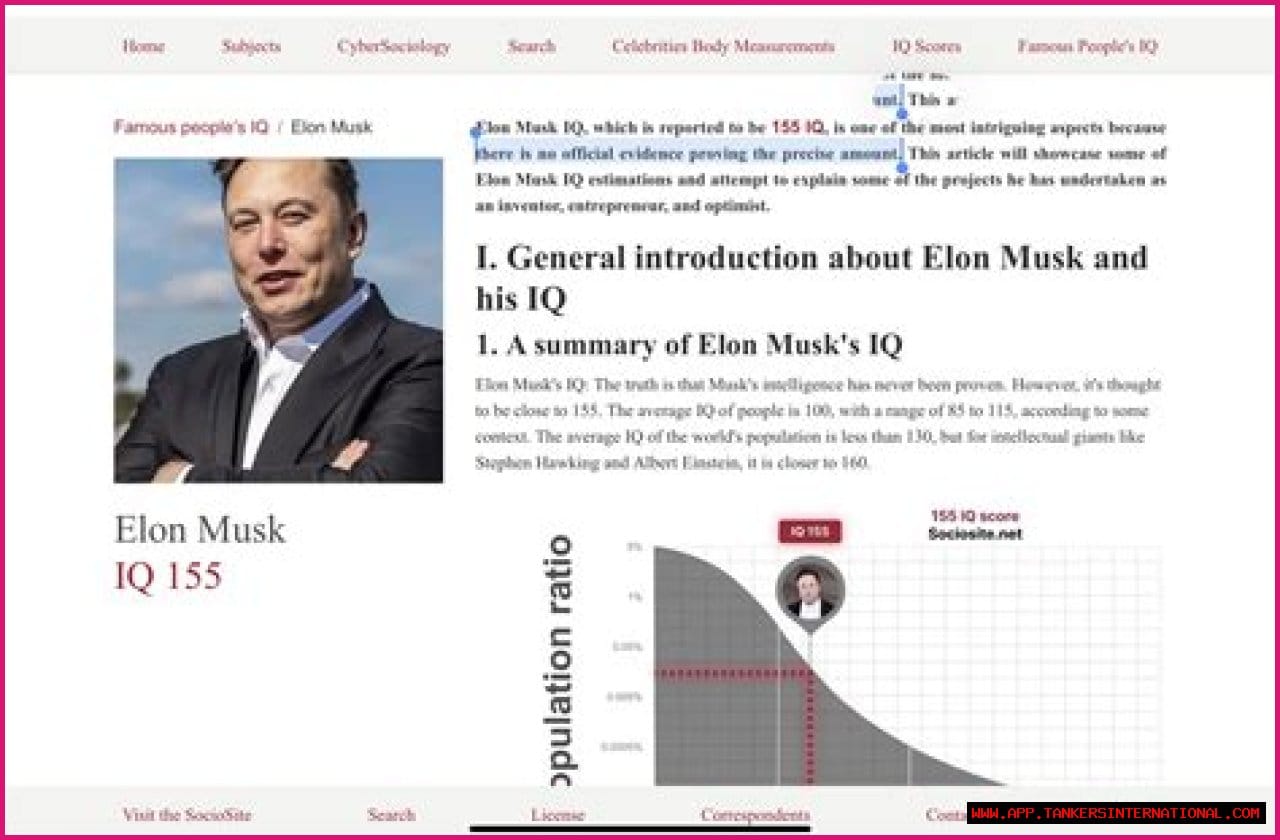
No verified official IQ score exists for Elon Musk. Estimates hover around 155 based on achievements and informal assessments, but he emphasizes output over test numbers.
Can IQ tests accurately measure genius like Musk’s?
IQ tests gauge specific cognitive skills effectively, especially abstract reasoning via Raven’s Matrices, but they miss creativity, motivation, and real-world application—key to Musk’s success.
How can I improve my IQ score?
While genetics set baselines, practice with puzzles, memory training, and novel learning yield gains. Average IQ is 100; consistent effort exploits practice effects for measurable uplift.
Does ADHD or neurodiversity relate to high IQ in figures like Musk?
Musk’s Asperger’s disclosure highlights neurodiverse strengths like hyperfocus, common in high achievers. No direct causation, but such traits often pair with elevated cognitive profiles in self-improvement contexts.
Related resources
elon musk iq: improve your results by practicing and tracking progress.